

Using "System.Text.RegularExpressions" in C# you have a lot of abilities to work with text. One of practice of using System.Text.RegularExpressions is working with IP addresses. (more...)
Using "System.Text.RegularExpressions" in C# you have a lot of abilities to work with text. One of practice of using System.Text.RegularExpressions is working with IP addresses. (more...)
There’re no associative arrays (hash) in common sense. There are Dictionaries for this. It’s a very good tool if you want to use link "key-value". Using Dictionaries, keys and values can be different types. (more...)
Each time I forget how to add new line symbol to string. I decided to add to memories. Below how to add new line symbol to string in C#.
string message = Label1.Text;
message = message.Replace("<br />", System.Environment.NewLine);
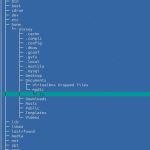
Some Linux-commands for work with archives from command line. In this tutorial we have this structure (Figure 1 and Figure 2): /home/alexey/Documents/mydir/ - is a directory for adding to archive. (more...)

It’s a little tutorial about how to get all duplicate records on namesakes example from your database table. For example, we have a table with columns Id, FullName, Birthdate and Phone.
Using 'GROUP BY' and 'HAVING' we can select all namesakes. (more...)
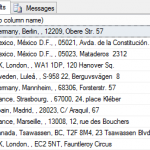
Concatenating of string columns is not very simple task in T-SQL if you don’t know ANSI standart of it. According to ANSI standart of SQL, concatenating of NULL-value is NULL in the result. It’s not clearly for developer, but it is so.
Let’s see some features for work with concatenating NULL-value columns. For example, I will use tutorial database Northwind and its table Customers. (more...)
This post is about which string functions there are in Transact-SQL. They allow to modify data you have, make custom queries to select records from database tables. To know them is very important for any developer - using string functions is very good way to decrease load from application server without adding it to SQL because string functions on SQL server work very fast. (more...)
Another way for using conditions in Transact-SQL besides IF…ELSE is CASE operator. The syntax is some different from IF…ELSE but in some cases more readable. CASE also uses the word "THEN". (more...)
On Microsoft.com you can download Microsoft® SQL Server® 2012 Express. It’s a free software for home use – education, tests or something like this. When you click "Download" link on a page http://www.microsoft.com/en-US/download/details.aspx?id=29062, you can see a list of versions for downloading. Which one to choose? (more...)
In this post I will write about SQL conditions. It seems to me that construction "IF ... ELSE" you can find in any language. Transact SQL is not exclusion.
Let’s see IF ... ELSE in action on the sample below. (more...)