
Create .Net application with RabbitMQ on your local machine
If you want to write an application which uses RabbitMQ, I advise you to use docker image of Rabbit. It's lightweight and can be easily executed.
Download and start docker image with a powershell command:
docker run -it --rm --name rabbitmq -p 5672:5672 -p 15672:15672 rabbitmq:3.12-management
Of course, docker must be installed on the machine 🙂
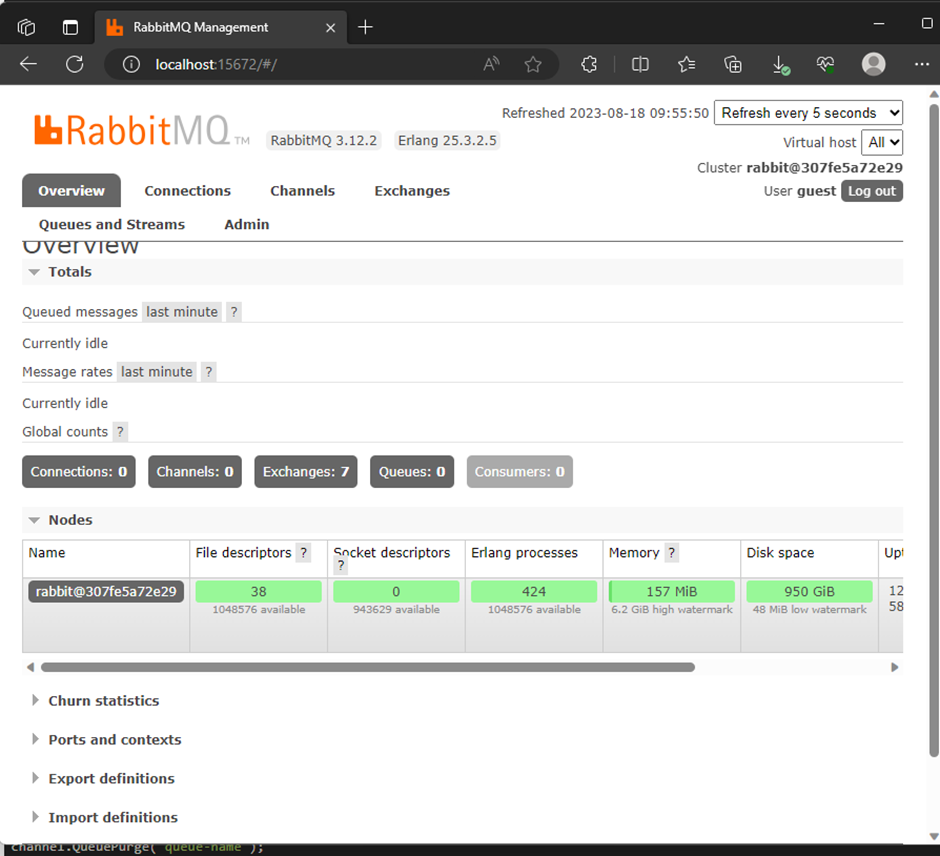
Administration url is http://localhost:15672/#/, default login-password are guest / guest. To set different credentials you can start docker with another command:
docker run -d --hostname my-rabbit --name some-rabbit -e RABBITMQ_DEFAULT_USER=user -e RABBITMQ_DEFAULT_PASS=password rabbitmq:3-management
Next step is to create console application in .Net 6 and add the package RabbitMQ.Client:
NuGet\Install-Package RabbitMQ.Client -Version 6.5.0
Simple example for the listener of RabbitMQ is here
using RabbitMQ.Client;
using RabbitMQ.Client.Events;
.......


        public void FirstAttempt()
        {
            var factory = new ConnectionFactory
            {
                HostName = "localhost"
            };
            var connection = factory.CreateConnection();
            Console.OutputEncoding = Encoding.UTF8;
            //Here we create channel with session and model
            using
            var channel = connection.CreateModel();
            //declare the queue after mentioning name and a few property related to that
            channel.QueueDeclare("product", exclusive: false);
            //Set Event object which listen message from chanel which is sent by producer
            var consumer = new EventingBasicConsumer(channel);
            consumer.Received += (model, eventArgs) => {
                var body = eventArgs.Body.ToArray();
                var message = Encoding.UTF8.GetString(body);
                Console.WriteLine($"Product message received: {message}");
            };
            //read the message
            channel.BasicConsume(queue: "product", autoAck: true, consumer: consumer);
            Console.ReadKey();

} Net 10.0 is not available for Azure Functions. How to fix
 Custom Label with multiple styles in TextField of Fluent UI
 First impressions after using the new SPFX 1.22.2 with Heft